



It’s logical to assume that larger speakers produce more bass and perhaps play louder than smaller models, and sure, this is often true. However, before assuming the larger alternative is the best choice, ask yourself: how you intend to use your audio system? Will it mostly provide background ambiance, or do you sit and really listen? Are you expecting a lifelike rendition of performers in your room, or are you happy with the sound blending in with your environment?
If a convincing portrayal of a musical performance is a must, then depending on the size of your listening room, a smaller speaker might deliver more than its larger counterpart. Here’s why.

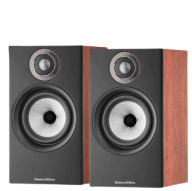
Smaller speakers are easier to build.
Their smaller cabinets are less likely to require costly resonance control and usually have fewer ‘speakers’ (drivers) in the cabinet. Fewer drivers often translate to a more cohesive sound from the lowest to highest frequencies. Larger speakers with more drivers commonly use completely different materials in each driver; those materials carry their own sonic signature, and this can lead to a disjointed effect on the sound from frequency to frequency. More drivers also mean there's more electronic dividing of the frequencies within the speaker by a device known as a crossover. The more the signal is split to individual drivers, the greater the potential there is for signal loss and distortions to occur, which will affect the timing of sounds reaching your ears when listening. This is known as phase distortion. In this case, you’ll hear a vague representation of where instruments and voices are placed, but the specificity required for it to be believable is absent.

In a larger speaker, these challenges are solvable, but at a cost.
If the cost is no object, the bigger speaker will certainly deliver a more authoritative and exciting sound. Speaker designers very often design and perfect a small speaker first, making sure that the listener enjoys a precise spatial rendition of the music, and that instruments and voices are presented in the most natural-sounding way possible given the design budget, before they typically progress to making larger models that still maintain the musical accuracy of their smaller siblings. In doing so, they navigate the aforementioned challenges, and understandably, the costs add up very quickly. However, when achieved, the listener enjoys an accurate rendition, not only in terms of sound placement, but with the added benefit of lifelike scale to the sound. This is partially due to the addition of lower frequencies
Small speakers have limitations when it comes to producing deep bass, so lower frequencies tend to be a trait of larger speakers. Our advice on this, however, is that if on a budget, you should consider forgoing the lower frequencies that the larger speakers are capable of in favour of the spatial and tonal accuracy that the smaller options in the same price bracket are likely to accomplish better; this tends to be the tradeoff in more economical large speaker options. There is also the case for adding a subwoofer to round out the bass performance later, but that’s another conversation.

But there is an exception!
It’s worth noting that this advice doesn’t necessarily apply to Home Cinema audio; you’ll likely be satisfied with the largest affordable speakers in this context. When enjoying movies, your attention is divided between sound and vision, and the spatial and tonal advantages of small speakers become less significant to many. Plus, the extra bass from the larger speaker is a total hoot, especially in any action scenes! Your neighbours might not think so, but hey…
Consider not only room size, but the genre of your favourite music too.
The case for small speakers potentially offering more bang for your buck is valid when the speakers aren’t swamped by the sound energy requirements of a large room. Small- to medium-sized rooms can offer great environments for listening to small speakers, and this is even more true if you’re interested in acoustic music (folk, small classical works, jazz, etc.). Indeed, the intrinsic detail that makes these genres so captivating is sometimes better served by a class-leading small speaker; large amounts of bass energy and volume are not what make such music attractive.
A big room naturally has different requirements. This is compounded if the music in question is high energy or large in scale (rock, symphonic classical, electronic, James Last played loud… etc.). A quality larger speaker, typically floorstanding, is going to be far more convincing provided the amplifier is up to it. Oh yes, you’re going to need a fair bit more power from your amplifier!
How about large speakers in a small- to medium-sized room?
Glad you asked! Yes, it can be done, and when done right, the result can be wholly immersive. Some large speakers are very refined and controlled in the lower frequencies and as such don’t sound ‘bloated’ or aggressive when properly positioned. Also, there are examples of bigger models that have excellent integration between the drivers, so you’re less aware of there being multiple in the cabinet. If the drivers aren’t well-integrated, then tonally-speaking, sitting at a smaller distance as a smaller room demands will make any faults in this area obvious. By this we mean it will become noticeable to the listener that they are listening to a piece of audio equipment rather than being transfixed by a musical performance.
At the end of the day, the right choice for you is very situational; there is no ‘one size fits all’ for achieving the best sound. We’re here for that exact reason – to listen carefully to your requirements and expectations, and demonstrate the best options.
Book your demonstration here. We have 10 dedicated demonstration rooms in our Hawthorn East showroom to ensure you can experience sound that is tailored to your current and dream living spaces. Bookings are not required but guarantee that one of the team members will be available to help you at the best time for you! Alternatively, you can contact us at any time via email at info@tivolihifi.com.au or call us during Tuesday to Saturday during open hours on (03) 9813 3533. We ship Australia-wide!